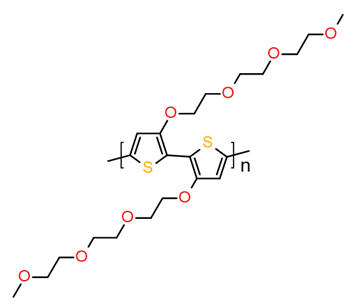
pgBTTT, the OECT benchmark material, is now ready for your advanced research.
Please click the exampled COA below for more information

Materials for those who understand quality
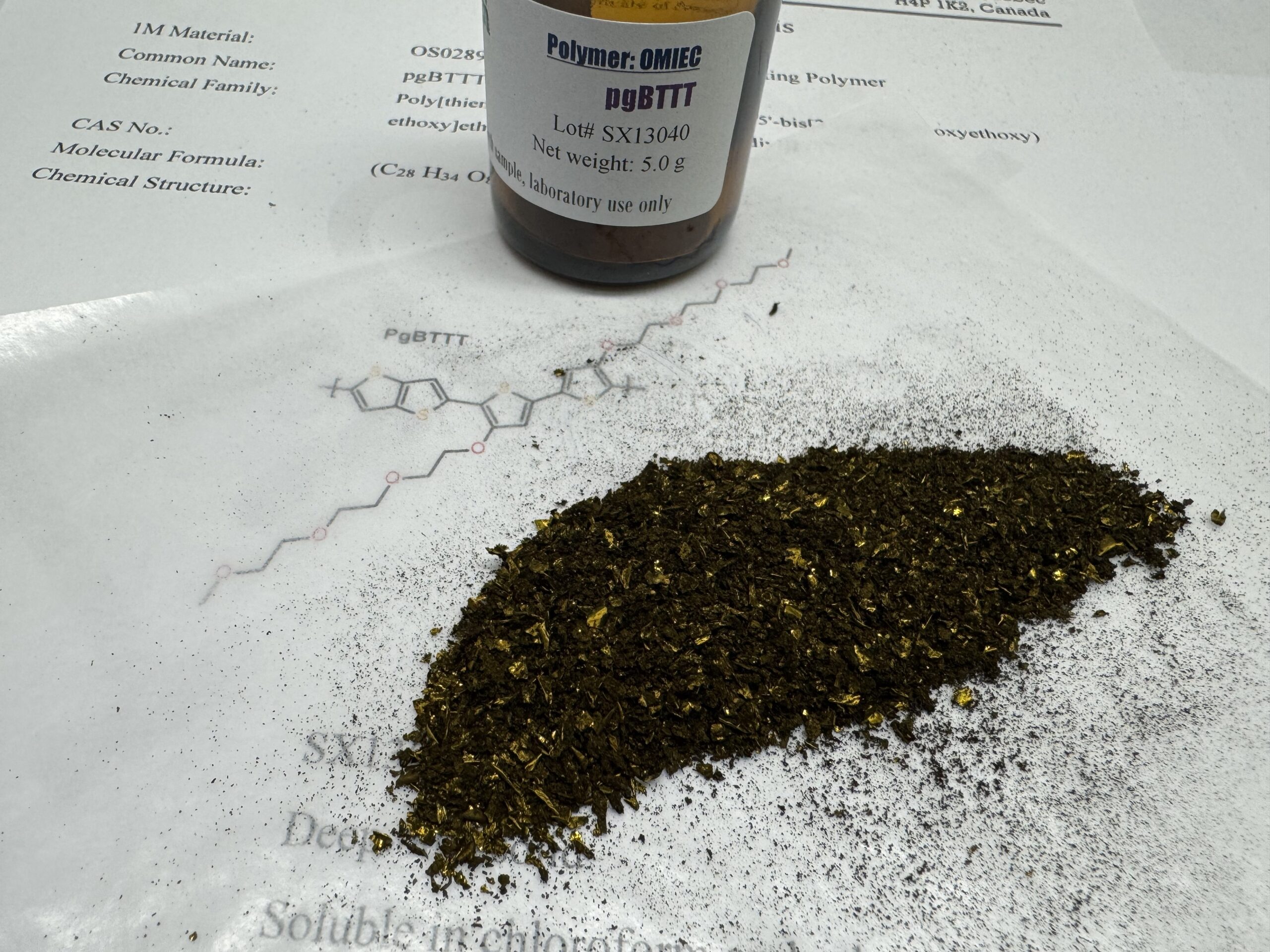
pgBTTT, the OECT benchmark material, is now ready for your advanced research.
Please click the exampled COA below for more information
1M TDS P90 P100 and More for you to explore
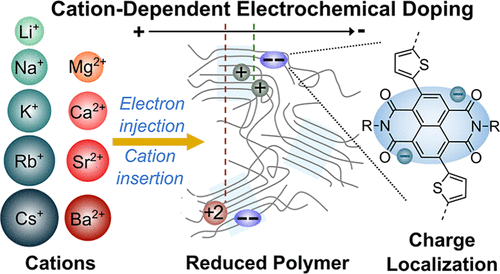
Mixed ionic-electronic conductors, also known as mixed conductors, are an increasingly important category of materials with applications in energy storage, electrochromic displays, bioelectronics, sensors, electrocatalysis, neuromorphic devices, thermoelectrics, and actuators.
Mixed conductors exhibit both ion and electron/hole conductivity, and ionic-electronic coupling (i.e., capacitance), allowing them to effectively transduce ionic signals to electronic ones, and vice versa.
In recent years, new mixed conductors have been developed beyond the traditional metals oxides and phosphates to include (semi)conducting polymers, radical polymers, perovskites, and hybrid organic-inorganic materials, enabling improved performance and new functionalities.
Structured below are examples of polymeric mixed conductors from 1-Material Inc.
1M Supports Material Research Society (MRS) constantly with reproducible Organic Nano Electronic (ONE=1) materials.

Would the emerging poly(benzodifurandione)[PBDF, PBFDO] reported having an unprecedented high electrical conductivity upon reduction (“n-doping”) with protons, high optical transparency and low work-function, be outmatching the predominant counter-partner PEDOT:PSS? Please check links below to find more.

2TDPP-OD-TEG is available for your research needs. For more information, please review the typical COA as exampled below:

New organic mixed ion-electron conductors OMIEC polymers, basing on DPP-TEG are available for you: